It is heartening to see that Britain's Royal Air Force and Royal Navy has been so active in effectively rescuing civilians from Libya. In sharp contrast, it seems there is something of national outrage in the USA today, many folk there being indignant at the American government for its failure to send in the US Air Force on similar rescue missions to Libya.
USAF is the largest and best-equipped air force in the world, so its curious failure to lend a hand in the evacuation of its citizens from Libya clearly must have been caused by lack of decision right at the top – the White House. Observers can only suspect either that Pres. Obama tends to favour the Moslem world, or he is simply too timid to intervene for fear of alienating his US political support base.
As an aside, don’t even mention Canada’s craven lack of assistance for Canadians trapped in Libya. Thousands of Canucks were caught in the uprising there, and those who did manage to get out on their own have nothing but contempt for the utter lack of help by Canadian officials on the scene. None of Canada's military aircraft planes have been sent there to help with evacuation either.
Having said that, I am filled with dread at today’s hints by Britain and America they may send a military intervention force into Libya. No! No! No! Any Western troops sent into north Africa, no matter how laudable their intentions to "preserve human rights" by using military might against Gadhafi, will surely unite the entire Arab world in resentment against the West, and could provoke a Jihad holy war against us all.
We must keep our armed forces out of that hell-hole, or we risk Armageddon, a hopless quagmire far worse than even Afghanistan.
Monday, February 28, 2011


Thursday, February 17, 2011

BAHRAIN UPRISING COULD BE HAZARDOUS
FOR UNITED STATES NAVY PRESENCE IN
ARABIAN GULF REGION
The wave of Middle Eastern anti-government rioting that has now rippled into Bahrain could lead to serious problems for the United States Navy's strategic presence in the region. The US Navy's Fifth Fleet is stationed there, which provides a powerful military base of operations against the Taliban and other potential adversaries.

Bahrain's current uprising is largely a sectarian religious struggle between two Islamic sects -- the Sunni-controlled autocratic government of King Hamad, and the largely Shiite population with strong popular links to Iran. If the rebellion does lead to a radical shift in political control, it could include demands for the USN to quit its base there, a potential threat to America's ability to support military efforts by Coalition forces in the region.
Bahrain's current uprising is largely a sectarian religious struggle between two Islamic sects -- the Sunni-controlled autocratic government of King Hamad, and the largely Shiite population with strong popular links to Iran. If the rebellion does lead to a radical shift in political control, it could include demands for the USN to quit its base there, a potential threat to America's ability to support military efforts by Coalition forces in the region.
Thursday, February 10, 2011
THE NIGHT THE YANKS A-BOMBED CANADA

United States Air Force Convair B-36 bomber
that crashed into the Canadian wilderness.
With the approaching 66th. anniversary of the WWII detonation of two atomic bombs on Japan, it is timely to recall that Canada also experienced the dropping of a similar US weapon, though inadvertently. This now largely-forgotten incident happened on February 13, 1950, five years after the Hiroshima and Nagasaki bombings. In 1950, a fearful world was caught in the Cold War, a tense military stand-off between the Soviet Union and the United States, then the world’s most powerful rivals.
Late in the afternoon of that day, a Convair B-36 “Peacemaker” heavy bomber aircraft of the United States Strategic Air Command took off from Eileson Air Force Base, Anchorage, Alaska, during a bitterly cold blizzard. Its high-altitude flight-path would pass over British Columbia en route to California on a simulated combat mission to test San Francisco’s defences against possible future Soviet attack. The plane’s mission was typical of that era’s airborne practice exercises by U.S. and Canadian air forces, which closely co-operated to defend North America against possible incursions by Soviet bombers.
The six-engined giant B-36 had a wingspan of 70 metres (230 feet), making it the largest bomber ever built by the U.S. It cost $6 million and carried 17 crewmen. Also aboard was an inert atomic bomb much like the 19-kiloton weapon - dubbed “Fatman” – that had been dropped on Nagasaki in the Second World War. Though the practice bomb aboard the B-36 was a fully-functioning weapon, it contained lead for the core instead of plutonium, and so was not capable of creating a devastating thermonuclear blast. Still, it was armed lethally enough, packing several thousand pounds of conventional TNT high explosive for emergency use in vaporizing the shell of IA-grade uranium (which itself did not present any radiation danger.)

"Fatman" atomic bomb similar to the
weapon detonated over Canada in 1950.
The B-36's routine training mission turned into a nightmare for the crew and even threatened British Columbians as they slept innocently below its droning passage through the black winter night.
Six hours into the flight, the huge plane encountered an increasingly violent winter storm that rapidly built up heavy icing on the wings and pusher-propeller engines. The aircraft’s pilot, Capt. H.L. Barry, said afterwards, “We were at about forty-thousand feet when iced-up carburetors caused three engines to burst into flames, the aircraft became very difficult to control, and we started to lose altitude"
Down to 14.000 feet, he radioed an urgent distress call for assistance at 11:25 p.m. "Engines on fire. Contemplate ditching on Queen Charlotte Sound. Keep lookout for flares or wreckage.” Lt. Paul Gerhart was the plane’s radar officer; if required, he was also responsible for dropping and detonating the bomb so as to avoid it falling into the hands of possible enemies. There was always anxiety in Washington that Soviet intelligence agents might try to retrieve a U.S. atomic weapon if one ever went down intact, to examine its secrets. With the plane obviously about to go down, there was urgent need to neutralize its deadly cargo.
“It was about midnight when I salvoed the bomb,” Gerhart recalled, “It detonated about 4,000 feet above the Pacific. There was a tremendous flash in the sky somewhere near Hectate Strait, apparently not witnessed by anyone below.”
The massive B-36 was falling 300 feet per minute when Capt. Barry set the automatic pilot to fly southwest, and ordered his crew to bail out immediately. Radio Sgt. Vitale Trippoldi’s last act was to tie down his Morse key so it would keep transmitting a steady location-fix for rescuers. Then the 17 crewmen parachuted out in rapid succession, and as they floated down caught sight of their blazing bomber still flying in a slanting course.
The first response to the distress call came from the Royal Canadian Air Force’s 123 Search & Rescue Squadron based at Sea Island, Vancouver, BC. There was quick follow-up by the destroyer HMCS Cayuga, then ships from Victoria, and various vessels and planes from RCAF Base Pat Bay. All of them sped northward along Vancouver Island.
Soon, they were joined by an armada of two dozen American ships and 70 aircraft that converged in a large-scale effort to locate the missing aircrew. Because their exact whereabouts were unknown, the search covered an area about 50 miles wide and 400 miles long, stretching along the coast of British Columbia.
Weather had turned nasty, with low temperatures, high waves, driving rain, and thick fog that made poor visibility. As there was scant chance of the downed flyers surviving long in the freezing-cold Pacific, search efforts concentrated first on the ocean waters.
The crash caused great interest in the city of Victoria, where people followed the details and anxiously waited for any news of survivors. But hope faded after 48 hours, when no trace of the airmen could be found at sea despite the massive search efforts. Teams of U.S. and Canadian service personnel, together with local On land, First Nations people, turned to scouring the wooded ravines of islands in Queen Charlotte Sound.
Then glad news came with a radio call from Vince King, captain of the B.C. fishing-boat Port Perry, who said he was bringing in nine survivors of the B-36 crew. Soon afterwards, HMCS Cayuga announced the rescue of another two USAF men from Price Island. Eventually, 12 of the missing airmen were rescued from various locations on rugged Princess Royal Island.
Sad to say, the first five men to evacuate the aircraft were never seen again after they parachuted into the darkness. Apparently, they drowned in the cold Pacific waters. Three others who fell into the sea were able to inflate their small life-rafts and survive long enough to be found by searchers. Most of the rest had been fortunate enough to fall on land, although they were widely separated from each other, lost in the densely-wooded rough terrain of the sparsely inhabited islands.
A few airmen were critically injured when they hit the ground, particularly Sgt. Trippoldi. His parachute snagged in a tree, injuring his shoulder and leaving him hanging upside-down by an ankle for 12 hours before being found by two of his crew-mates. Other airmen suffered broken bones or frostbite, but all were safely hospitalized or returned to their thankful families within hours.
American officials were fulsome in their gratitude to the Canadian rescuers, but they made it clear that the accident was classified as top secret. For months after, USAF insisted on carrying out its own search for the missing aircraft – and any of its atomic weaponry that might be recovered. However, no trace of the wreck could be found, and location efforts were finally abandoned.
The mystery of the missing bomber was finally solved three years later. In June, 1953, people searching for a downed Canadian civilian aircraft instead came across the B-36’s remains strewn along a high ridge on Kaloget Mountain beside Kispiok Valley, 360 metres from where its crew bailed out. The investigators retrieved a few bits of radar equipment, the used explosives to demolish the airframe fragments.
Today, the resting-place of the first plane to lose an American atomic bomb is designated a “heritage wreck-site” protected forever by the B.C. Archeology Branch.
Tuesday, February 08, 2011

"HERZL STREET" NOVEL IS SET DURING PALESTINE’S THREE-WAY CONFLICT.
Today’s continual turmoil in the Middle East has its roots in the decades-long bitter enmity between Arabs and Israelis. Though historical events there have been dramatically violent and complicated, there are strangely few fiction novels set there. One rare example, though, is Herzl Street by Maurice Tugwell, published by Xlibris.
Victoria, Canada, author Maurice Tugwell's fine novel is set in 1948 Palestine, just short days before the founding of present-day Israel. As well as being a "rattling good read," his book helps explain why even now -- more than 60 years after the end of the Palestine Mandate made way for the state of Israel -- the region still remains the centre of continuous political wrangling and sporadic warfare.
Herzl Street offers insights into this tangled arena, through the fact-based fictional experiences of a 19-year-old second lieutenant in the British army. Maurice Tugwell has first-hand knowledge of his subject, being a retired brigadier of the British Army who himself served in Palestine as a junior officer with the Parachute Regiment. He clearly explains how the conflict actually involved a complicated three-way war; Arabs and Jews against the British, Jews against Arabs, and Jews against Jews.
Tugwell effortlessly weaves into his tale details of how ordinary British soldiers coped with their thankless task of overseeing the formation of the new country of Israel, while keeping the peace between Arabs and Jews who were already at each other's throats. Each side committed' atrocities, and guerrilla warfare killed 147 of the hapless “Tommies” who were caught in the middle.
This labyrinthine atmosphere forms the backdrop for Tugwell's story of intrigue, violence, and treachery. His youthful protagonist, Second Lt. Jonathan Wildblood, faces hostility from jaded officers before being pitched into combat against Arab and Jews equally determined to kill him. Along the way, he discovers a conspiracy of gun-running by a few members of a neighbouring army unit.
Along the way, Wildblood experiences a sensuous love affair with a gorgeous young Arab woman, and also encounters a cellarful of admirable enemy agents. Herzl Street is written in lean prose, with the perfect pitch of authentic 1940s attitudes. Maurice Tugwcll's paratroopers talk the way British soldiers actually spoke back then, sharing their deadpan humour and comradeship, and he gives both Jews and Arabs their say a well.
-- S.A.
Film footage - 1947 Palestine:
http://www.britishpathe.com/record.php?id=57324
-- S.A.
Film footage - 1947 Palestine:
http://www.britishpathe.com/record.php?id=57324
Monday, January 31, 2011
"BLACK DIARIES" OF CASEMENT AUTHENTICATED
AS GENUINE BY EXPERTS.

Sir Roger Casement,
executed for treason in 1916.
Expert researchers have authenticated the notorious diaries of Irish rebel Sir Roger Casement which record his homosexual activities and perhaps contributed to his execution for high treason in 1916.
Some of Casement's supporters have contended the so-called "black diaries" were forged to smear his character during his trial. Since they were made available for study in 1959, there has been a reluctantly growing acceptance they might in fact be authentic, and now experts have declared the diaries be genuine.
Casement, born in 1864, was a formerly respected British civil servant knighted for his crusading accounts of Belgian exploitation of natives in the Congo and by rubber-plantations in South America. Disillusioned with Britain's refusal to grant independence for Ireland, he travelled by U-boat to Germany during the First World War to seek funding and weapons for an Irish uprising. He also visited several prisoner-of-war camps in Germany in vain attempts to recruit Irish soldiers to change sides and fight against England.
Casement was captured by British soldiers after he sailed back to Ireland aboard a trawler carrying 20,000 German rifles. The subsequent Easter Rising in Dublin failed and seven commanders were shot by firing squad. Casement was taken to London, where Prime Minister Herbert Asquith and his cabinet debated his fate. He was tried at the Old Bailey Court on charges of high treason and hanged in 1916.
During his trial, Casement's personal diaries were introduced into evidence. The handwritten diaries recorded graphic details of Casement picking up young men and teenaged boys for sex in Africa and Ireland. Documents released in 1995 showed British authorities in 1916 used the diaries to smear Casement. At the time, sodomy was considered to be gross indecency, and a criminal offence. "I see not the slightest objection to hanging Casement and afterwards giving as much publicity to the contents of his diary as decency permits," wrote Sir Ernley Blackwell, undersecretary at the Home Office.
Now, the diaries have been subjected to handwriting analysis, ultraviolet light, and electrostatic detection tests, said forensic scientist Prof. Bill McCormack of Goldsmiths College, University of London. "The inescapable conclusion is that they are authentic," he said. "I am very confident, because of the scale of this operation."
Whether the diaries made a difference in Casement's fate remains debatable. "I am not a professional historian, but my educated guess, is that he would have been reprieved in the absence of the diaries," McCormack said.
Seamus Osiochain, a biographer of Casement, disagrees. "His trial happened at the same time as the Battle of the Somme was raging, and he had conspired with the Germans," Osiochain said. "I don't think it [the diaries]would have swung the outcome either way."
Saturday, January 29, 2011
LT.COL. JOAN KENNEDY -- CANADA'S FIRST
FEMALE SOLDIER
FEMALE SOLDIER
by Sidney Allinson.

Joan Kennedy was the first Canadian woman
to receive an Army commission
Canadian women who now rightly enjoy full equality in every walk of life may not realize how much they owe to an almost forgotten housewife who was instrumental in forming the Canadian Women's Army Corps [CWAC] early in World War Two.
More than half a century ago, Joan Kennedy assumed command of the Canadian Women's Army Corps that was formed by her personal initiative, despite official short-sightedness and gender prejudice. From local beginnings as leader of a group of volunteers, she went on to spearhead the national formation of the CWAC, in which women became part of the Canadian army for the first time.
She was born Joan Barbara Fensham in Middlesex, England, in 1908, daughter of an immigrant banker who became an Alberta farmer. Having contracted malaria during the First World War, Harry Fensham resettled his family in the gentler climate of Victoria. After matriculation from highschool, Joan worked as a telephone switchboard operator, then became an accountant with the B.C. Bond Corporation.
Described as "a slim, vivacious girl with short wavy hair and blue eyes, fond of a good time," she married Norman R. Kennedy, a B.C. government engineer in 1929. The bride dutifully quit her employment, as was then expected of women upon getting married. The change to being "Mrs. Norman Kennedy, attractive young housewife and club-woman," cannot have fully suited her energetic temperament. Still, she occupied herself with vigorous fund-raising for Tiny Tim Cots in Victoria hospitals.
Evidently, she was also a shrewd observer of world affairs and the growing threat of war with Nazi Germany. Early in 1939. Joan Kennedy joined with other like-minded women to form the British Columbia Women's Service Corps,' and became its commandant. Without any government' support, members of the BCWSC made their own military-style blue uniforms and trained themselves in practical skills likely to be needed in a war.
The British Columbia women were first, then similar groups formed in other provinces across Canada. Each proved their foresightedness and value after the Second World War was declared in September, 1939. Few, if any, women in Canada at the time expressed the slightest desire to go into front-line combat. Nevertheless. they held strong patriotic feelings. and were determined to serve in any vital support roles opened to them.
The British Columbia women were first, then similar groups formed in other provinces across Canada. Each proved their foresightedness and value after the Second World War was declared in September, 1939. Few, if any, women in Canada at the time expressed the slightest desire to go into front-line combat. Nevertheless. they held strong patriotic feelings. and were determined to serve in any vital support roles opened to them.
The aptitude of women to perform a variety of military jobs caught Kennedy's imagination. Almost single-handedly, she began a determined campaign to persuade the Dominion government to co-ordinate various women's voluntary organizations into a national army unit. For more than two years, she faced total indifference from politicians and downright hostility from military headquarters. Calmly, she kept' pointing out the successful example of half a million women already serving in the British armed forces. But hide-bound attitudes and well-entrenched prejudice towards women prevailed in Canada in those days. One brass-hat spluttered to her, "A petticoat army madness!"
After being turned down by three successive ministers of defence, Joan Kennedy's persistent lobbying finally paid off. On Aug. 13, 1941, the Hon. John Ralston signed an Order-in-Council to authorize formation of the Canadian Women's Army Corps. The new unit suddenly gained priority; and Elizabeth Smellie, matron in-chief of the Canadian Army Nursing Service, was seconded to organize the CWAC's administration.

CWACs on parade
Meantime, Joan Kennedv was admitted into the army with the rank of major -- the first Canadian woman to receive an Army commission - and appointed Staff Officer CWAC: Military District 11, headquartered at Work Point Barracks, Victoria. Because of Kennedy’s obvious suitability Chief Matron Smiellie soon recommended her to be appointed as commander of the CWAC, promoted to the rank of lieutenant-colonel.
By then, Canada's women had become part of an enormous effort to gear up: the country’s post-Depression industry into a powerful wartime production effort. Previously, the full potential of women had been untapped, relegated to occupations thought of be "suitable women's' work." However, females soon showed their stuff in jobs as welders and lathe-operators, helping build ships and tanks and aircraft.


Even more of a novelty in Canada was the innovative sight of women in military uniform. CWACs were outfitted in well-cut khaki tunics, shirts, and skirts, plus trousers usually worn only while on such duties as driving trucks. Each individual woman's clothing measurements were forwarded to Army Central Stores in Ottawa, so individual uniforms were tailor-made. Officers were allowed silk stockings, while other-rank legs wore lisle, and an allowance was paid for the purchase of civilian lingerie.
Regulations required female recruits aged between 21 and 40, with a minimum height of five feet, weight no less than 105 pounds, and having no dependents.. They were to have at least Grade 8 education, and be British subjects, as Canadian citizens were at the time. Basic training consisted of squad drill, marching, physical education, and military, deportment, but without any weapons instruction.
When critics suggested that rigid army life could turn females into masculine individuals, Kennedy snapped, "No, life in the CWAC will never rob a girl of her charm or her womanly qualities! Whatever tasks they undertake, they'll do them in a woman's way:"
She was forthright about what were tasks to be expected. "Any woman who goes into this with the idea of finding glamour is entirely misled;" she said. "Her job will probably be pounding a typewriter, scrubbing floors, cooking, or something equally commonplace but necessary."
Kennedy's emphasis continued to be on craning women capable of non-combat duties to relieve men for front-line service. Early requirements were for clerks, telephonists, cooks, and drivers, out eventually CWACs were performing scores of demanding military skills, including code-ciphering, motor-mechanics; and map-mating.
Whatever their rank, women received only two-thirds the pay of a male soldier. female private got 90 cents per day, compared with $1.30 for a man. Lt. Col. Kennedy's daily pay was $6.70. (A man in an equivalent position, commanding an entiire corps, usually held the rank of general.)
In 1943, after some understandable grumbling about inequality of earnings, CWAC pay was raised to 80 percent of a man's rate_
Early on, Kennedy did not see her unit having any revolutionary effect on women's status in society. In 1942, she said, "We are only in for the duration, In post-war years, women will return to the same position they enjoy in the business world. They are the housewives of tomorrow."
Her perception changed rapidly, though, when she saw her womens’ enormous capabilities, and she began to muse publicly about her changed view of the near future. "Canadian women on active service won't be content with a frivolous or idle life after the war is over. A life of teas, bridge, and gossip will be empty, after the important job they're doing now w Most will want to do something more useful in their community.”
Within a few months of the unit's formation. 80 members were sent to Washington, D.C., working at the British Military Mission.-They made such an impression in the U.S. capital, a platoon of them were invited to march in a U.S. armed forces parade down Fifth Avenue, New York.

One newspaper gushed, “Those smart Canadian gals in khaki stole the show!"

One newspaper gushed, “Those smart Canadian gals in khaki stole the show!"
The first draft of 350 CWACs went overseas in November, 1942, to serve in London, England, and eventually 3000 served overseas. They bravely endured Luftwaffe bombing raids, and in Nothwest Europe, the first female Canadian soldiers to come under fire. Later in the war, 43 CWACs served in Italy, 156 in Northwest Europe, and eventually 4,000 were stationed overseas. During the war, 25 CWACs died in WWII, as result of accident, injury, or disease. No CWACs were killed by enemy action, but four were wounded by a German V2-missile attack on Antwerp in 1945.

After being posted to Britain for a while in 1944, Lt.-Col. Kennedy returned to Canada to be appointed General Staff Officer in charge of training for the CWAC. Her ability was further recognized by being appointed to an army board to organize formation of the new Royal Canadian Electrical and Mechanical Engineers, a highly technical regiment. Having demonstrated her versatility yet again, she returned to administering the CWACs until after war's end in August, 1945.
The competence shown by females in general during the Second World War helped change forever the way in which women were viewed by the military establishment and Canadian civilian society in general. Success of the 21,000 "Kennedy CWACs" not only paved the way to equal status for females in the Canadian Forces. They had an even wider influence on later generations' radically changed perception of women in all career roles.
The CWAC was disbanded in September, 1946, then re-formed three years later, including a local Victoria platoon of women in 155 Coy., RCASC, later the 11 (Victoria) Service Battalion. After Canadian unification of the three armed forces in 1968, women blended into the ranks of most units, becoming simply soldiers, sailors, and airforce personnel. Finally, in 1989, the Human Rights Commission ordered that women were to be fully integrated into all aspects of the military.
Meanwhile, Joan Kennedy herself had been let go from the army in 1946, She returned to Victoria, obtained a divorce, and quickly adapted to home-town life again. She took mischievous fun in telling how previous military comrades of both sexes often passed by without recognizing her in civilian clothes.
The post-war years gradually became more difficult for her. Despite her executive skills, she faced an increasing straggle to make ends meet, and ended up trying to build a small secretarial business.
The whole city was shocked when she died suddenly of a heart attack at her Rockland Avenue home on Oct.11, 1956. She was only 47 years of age; her early death more than likely the result of strain from overwork during five gruelling years of wartime responsibility.
The only Canadian woman ever to be accorded a funeral with full military honours, her casket was draped with the Union Jack and home on a gun-carriage flanked by six army officers as pallbearers. The procession marched slowly; through streets lined by Victorians standing to show their respect. Then Joan Kennedy's ashes were laid to rest in an unmarked grave at Hatley Park Memorial Gardens, Colwood, British Columbia. Forty-three years later, in 1999, a special plaque dedicated to her was unveiled at the Ashton Garrison Museum, Victoria, BC, where her personal effects are held. It has become the primary museum of the CWAC, which houses a large collection of female uniforms and related artefacts. Other CWAC related materials are held by the Museum of Esquimalt Naval Base, Victoria, BC.
Further recognition took place in August, 2001, to commemorate the 60th anniversary of the Canadian Women's Army Corps. A military guard of honour from the II (Victoria) Service Battalion paraded for a special religious ceremony at Lieutenant-Colonel Joan Kennedy's burial-place, where a suitably inscribed headstone is to be erected to memorialize Canada's first female soldier.
Lt. Col. Joan Kennedy, founding Commandant of the Canadian Woman's Army Corps (CWAC) and staff officer second to assist in the formation of the Royal Canadian Electrical Mechanical Engineers (RCEME), was the first Canadian Woman to receive a full military funeral in 1956. There was no graveside service after Kennedy's funeral, and this pioneer for all Canadian military women was buried in an unmarked grave and largely forgotten.
Many ex-CWACs stayed in close contact with each other for many years after their demobilization in 1946, to keep alive the memory of their service together. One such group of women in Kitchener, Ontario, proudly arranged a statue to their corps.

Many ex-CWACs stayed in close contact with each other for many years after their demobilization in 1946, to keep alive the memory of their service together. One such group of women in Kitchener, Ontario, proudly arranged a statue to their corps.

However, Joan Kennedy herself and her remarkable achievements had not been entirely forgotten. Aware of Kennedy's shamefully unmarked grave, the Ashton Armoury Museum made representation to Veteran's affairs Canada to rectify things, and also worked in partnership with the Last Post Society to provide a suitable headstone, which was erected in June 2001. Following the Remembrance Day Ceremony later that year, 11 (Victoria) Service Battalion, veteran CWAC's and RCEME, the Royal Canadian Legion, the Korean Veteran's Association, a Colour Party, and a large convoy of vintage World War vehicles made a long slow procession to the gravesite. So Lt.-Col Joan Kennedy finally received the long overdue graveside service and historical recognition that a woman of her accomplishments and stature was due.


Movie about Canadian women in military service during WWII:
Monday, January 24, 2011
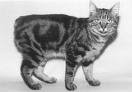
A MANX "TAIL" OF THE WWII AIR-WAR
He shared with me the saga of why there are now so many tail-less cats to be seen in the Flensburg area on the German-Danish border. Lucien swore he had first-hand factual knowledge that their presence is the aftermath of the crash of a Royal Air Force bomber aircraft in the Second World War.

On the night of October 1, 1942, 27 Halifax bombers of 4 Group RAF attacked the U-Boat base at Flensburg, of which 12 planes were shot down. Kurt Peuschel, then a 14-year-old local boy, and some of his school friends, were allowed by German Luftwaffe guards to inspect one of the crashed bombers, believed to be A/C serial number W7717 of 10 Squadron, RAF.
Guards told them that five of its Canadian crew had been captured uninjured and sent to a POW camp. Before leaving, the prisoners asked their captors to look for the crew's pet tomcat that had escaped from the wrecked bomber and fled into the darkness. The RAF flyers were all very fond of their feline mascot, which they had acquired while training on the Isle of Man.
It was a Manx cat, the unique tail-less breed that would be easily identifiable to searchers. Apparently, Kurt and his young friends were enlisted to help search the area for the tail-less cat, but without result.
Kurt later moved away to live in Switzerland, and visited his homeland many years later. While there, he saw a local TV station report commenting on the large number of cats without tails to be seen in the Flensburg area. The report attributed them to the wartime rumour of an RAF mascot survivor that went missing in action.
Kurt told his wartime story to the TV station, and a search for the survivors of the crew was taken up by the Canadian Embassy in Berne, but without success after such a long time has passed. Still, I like to think it is true that many descendants of a mascot Manx cat who fell from the sky long ago still roam the streets of Flensburg
Friday, January 21, 2011

SECRET GERMAN WEATHER STATION
ON CANADA'S LABRADOR COAST DISCOVERED
30 YEARS AFTER END OF WWII
-- Donna Andrew,
Marine Liasion Officer,Transport Canada.
Kapitan-Leutnant Peter Schrewe was only 23 years of age when ordered by the German navy to take command of his first U-boat. Mission: to establish, in the autumn of 1943, an unmanned automatic weather station in the northern Labrador Territory of Newfoundland. Purpose; to improve western Atlantic weather analysis for the German navy and air force (Kriegsmarine and Luftwaffe).

Kapitan-Leutnant Peter Schrewe
I was personally involved in helping solve this little-known mystery, when I embarked in Canada's largest icebreaker, the Louis S. St. Laurent, a Canadian Coast Guard expedition steamed through the frigid waters along the Labrador coast. Off its northernmost point, at Cape Chidley, the expedition found signs of one of the few Nazi operations on North American soil during the Second World War.
The tip-off about the covert operation came from retired German engineer, Franz Selinger. Selinger, who joined J. Y. Clarke, Canadian Coast Guard's fleet director, and Dr. Alec Douglas, official historian for the Department of National Defence, on board the St. Laurent in Dartmouth, N.S., on 12 July 1981.
Herr Selinger brought with him powerful evidence, not then wholly conclusive, that the Germans had landed on what was then the British Crown colony of Labrador, which became the Canadian province of Newfoundland-Labrador in 1949. It was obvious that if Selinger's evidence could be verified, we had a national news story on our hands. So I signed up for the trip.
For Douglas, the story began two years previously, when he received a letter from the Austrian-born Selinger, who is preparing a book on Arctic weather reconnaissance. Selinger wrote to Douglas at the suggestion of Prof. Dr. Rowher, of Germany's Stuttgart library for contemporary history. Rowher and Douglas had met at a maritime conference in Germany some years earlier.
Selinger's 1979 letter asked Douglas for details of two weather installation activities during the war. "There were, as we know," wrote Selinger, "contemporary actions of Germans and Canadian Forces in the same region where weather reconnaissance activities were to be observed." The first was on the German-controlled Norwegian island of Spitsbergen, north of Norway, where a Canadian raiding-force had landed in 1941, destroyed the coal-mines and evacuated the inhabitants to Britain. After the Canadian force left, German troops re-landed and operated a manned weather observation post there between October 1941 and July 1942.
"Later in the war," continued Selinger, "German U-boats landed on the coast of Labrador and established an automatic weather station that was later captured by the forces of your country." In the same letter, Selinger said that he had seen a photograph of such a station and would be "obliged" if Douglas would give him further details of the automatic weather station installed in Labrador.

U-boat crew emplacing Weather Station "Kurt"
on isolated coast of Labrador
Historian Douglas could tell Selinger much about Spitzbergen, but wrote back that he had no knowledge of any Labrador operation. "You get a little weary of unsubstantiated reports 40 years after the fact," explained Douglas. "All kinds of so-called sightings of Germans on Canadian shores during the war had been reported. To the last one, reports have been checked out but none of them has been conclusive: the evidence just never supports the rumor." Douglas suggested to Selinger that the automatic weather station to which he referred was "the one in Greenland, as Canada had certain interests there at the time."
Selinger was not deterred. The paper-chase was on. He wrote Douglas again. "You say there were no landings of German U-boats on the Labrador coast, but I wonder where the enclosed information comes from." In the course of his research, Selinger found and included in his letter to Douglas a photocopied reference to the WFL6 Weather Station Kurt (one of of a series of 21 wetterfunkgerat) established by a U-boat on the Labrador coast. Douglas conducted an exhaustive search. He inspected the files from the Royal Canadian Navy's Flag Officer Newfoundland. Nothing. He checked out resources of the commander in chief Canadian Northwest Atlantic; another dead end. The Eastern Air Command of the Royal Canadian Air Force had no positive authentic evidence. War diaries and military, federal, and archival records -- all were silent on the subject.
"It didn't help my search to discover that all headquarters operational records of naval intelligence had been destroyed in Ottawa five years after the war," said Douglas. "Some overzealous bureaucrat had tossed them -- all of them -- to the shredder."
Selinger, while investigating documents held by the son of a German meteorological scientist, Herr Sommermeyer, had stumbled on a series of photographs of which two in particular showed a German U-boat, and in the background, a different kind of terrain from all the others.
More importantly, there was something peculiar about the U-boat in the two pictures. The U-boat was a type IXC submarine, without the usual 20-mm. quadruple antiaircraft flak gun. [Unknown by Canadians at the time, the AA-guns had been torn off the U-boat by a fierce Atlantic storm during the voyage from Germany.]
These were important clues. First, the photos were definitely not Spitzbergen, Bear Island, or any other eastern Atlantic/Arctic site. Secondly, the type IXC boat suggested a distant operation. Such boats were selected for long-range missions. Thirdly, this boat should be easy to identify. Its armament was distinctive. Selinger thus had fresh evidence. In a search that took him through hundreds of U-boat logs, he found at last the log book of U-537 and the name of its young commander, Peter-Schrewe. There, unmistakably stated in Schrewe's meticulous recording of his 1943 mission was this entry from Kiel:
These were important clues. First, the photos were definitely not Spitzbergen, Bear Island, or any other eastern Atlantic/Arctic site. Secondly, the type IXC boat suggested a distant operation. Such boats were selected for long-range missions. Thirdly, this boat should be easy to identify. Its armament was distinctive. Selinger thus had fresh evidence. In a search that took him through hundreds of U-boat logs, he found at last the log book of U-537 and the name of its young commander, Peter-Schrewe. There, unmistakably stated in Schrewe's meticulous recording of his 1943 mission was this entry from Kiel:
Sept. 18 1943 Leaving port for first operational cruise
09:00 h Orders are to erect an automatic weather station on Labrador Coast--Canada.
Selinger immediately phoned Douglas in Canada, who called an old friend, Jim Clarke. Captain Clarke, commanding officer of HMCS Athabaskan in the 1960s, knew Douglas as a young naval officer. Both hadd kept in touch over the years. Alec filled me in on the investigative events of the preceding two years. He told me about Franz Selinger, about Peter Schrewe's log book, about the photographs. And above all he told me about Canada's sheer ignorance in face of the facts He also knew that our Canadian Coast Guard icebreakers made routine summer Arctic deployments up the Labrador coast to Lancaster Sound. Would it be possible, he asked, for Selinger to board one of our - icebreakers to chase down this amazing piece of research?"
Clarke became convinced of the incontrovertible evidence held by the German. It was certainly possible for Selinger to take passage in a Coast Guard icebreaker up to Labrador. In addition, said Clarke, it is withinthe mandate of the Coast Guard to assist other government departments on research matters. He would arrange not only for Selinger, but for Douglas and himself, to take the trip into the Arctic. "I had intended to spend time aboard a ship of the fleet this summer," Clarke said. "That we might find a little piece of history on our way was a further incentive."
Clarke, Selinger, Douglas, and I left Dartmouth on July 16, 1983, aboard the Coastguard patrol vessel 'Louis S. St. Laurent', under the command of Captain M. S. Tanner and at 14,000 tonnes the largest icebreaker in the Coast Guard fleet. Destination: Martin Bay, 32 kilometers south of Cape Chidley, due south of Baffin Island on the northern tip of the Labrador coast. On July 21, early in the Arctic morning, the icebreaker dropped anchor16 nautical miles from the rock-bound coast.
With Selinger's wartime photos showing prominent land features, and Peter Schrewe's navigational records, we boarded the St.-Laurent's helicopter and flew towards the coast. Making just a single pass around the mountain, we traced what must have been U-537's path up through the channel between Home and Avayalook Islands,-thence over Martin Bay.
"There it is," cried the chopper's pilot Les Bennetts, "Down there, on-the left." As carefully as a baby put down to sleep, the Bell 206LI set us down on a rocky ledge. Twenty meters away lay the remains of the German weather station.


Cape Chidley, Martin Bay, Labrador.
The discovery has since been widely recorded in the national and international news media. Peter Schrewe had indeed successfully completed, through a navigational nightmare, his mission to erect a weather station in Martin Bay, Labrador.
KaLu Schrewe later died on another U-boat mission, when U-537 was sunk with all hands by torpedoes launched from the American submarine "USS Flounder" off Java in 1944. He could never know that 38 years later the drama and danger of his mission were uncovered by a fellow German. Nor would he ever know that his mission would create international headlines and make him a public name in his homeland.
We found the corroded remains of that station, intact except for the transmitter, parts of the encoding device, and one of the module cannisters. German manufacturers' labels were visible on batteries and assorted devices.
Someone had been there before us, though whoever it was had probably dismissed it as a Canadian relay station. For Peter Schrewe's crew had convincingly carved on one of the weather canister heads the falsified inscription "Canadian Weather Service."
Like the layer upon layer which form the spectacular pack-ice of the Canadian Arctic, this story contains others within it. There is the story that captured international headlines. How a Canadian Coast Guard team located the first known evidence that this Nazi installation had been established on North American shores, 38 years after the event.
There is the story -- a highly technical one -- of how in the early 1940s, Germany held the state-of-the-art technology in radio communications.
There is a jigsaw story to delight any armchair military buff's sense of battle and history. Just how did this automatic station, transmitting weather information for the Germans during the late 1943 and early 1944, affect the timing and events of a most crucial phase of the U-boat war in the Atlantic?
There is a story to authenticate. Who dismantled the station in Martin Bay and when? [Subsequent research established that the radio device had not been dismantled; it simply ceased to transmit weather information only a few months after it was set up.] Did the Germans come back? Was it a casual Inuit hunting party? Was it a Canadian search and destroy team? Why was the transmitter taken? And who left behind a single undated .303 rifle cartridge shell, with the inscription "British Dominion?"
But the real story belongs to Peter Schrewe and Franz Selinger. It is “KaLu” Peter Schrewe, young and green, who guided his large submarine across an enemy-infested ocean and snaked past rocks and shoals to the barren shores of Martin Bay. Unwittingly, he made history in 1943. And it was Selinger, in pursuit of the facts, like a terrier chasing a fox to earth, who brought Canadian history back to Canada.

German Weather Station "Kurt" is now on display
at the Canadian War Mudeum, Ottawa.
RUSSIAN WAR DOGS SACRIFICED TO ATTACK GERMAN PANZER TANKS

Dogs and other innocent animals have been sacrificed by humans in warfare throughout history. One particularly affecting incidence is the use of trained dogs as anti-tank weapons by the Soviet Army to destroy German panzer tanks during the Second World War.
Initial tank-encounters during the German invasion of the Soviet Union in 1941 virtually wiped out the pre-war armoured inventory of the USSR tanks of the BT series, the T28 and T35. But soon the Nazi armour faced sterner opposition. Against the German Mark III and Mark IV. Soviet Army employed with great effect its highly-effective new T34 tank, its heavy KVI tank, and of course its land mines. But in addition it devised a new anti-tank weapon -- the mine-carrying dog.


Soviet Army anti-tank dogs. The dogs were kept hungry and trained to crawl under tanks to get their food. In the combat area, they were fitted with a special fabric harness which contained 10-12 kg of high explosive in four pouches. On top of the harness was a spring-loaded trigger pin. When the dog crawled under a tank the trigger pin was depressed setting off a detonator and exploding the charge.

Large contingents of dog-handlers were formed to train hundreds of large dogs to act as “suicide-bombers.” There is evidence that the dog was sent into battle during the 1941 autumn offensive against Moscow, and in South Russia in the areas of Kursk, Rostov, Stalingrad, and the Maikop oilfields.

"During the Great Patriotic War," they wrote, "dogs were used to destroy tanks. They usually attacked tanks from a distance of 150-200 metres. As the dog dashed under a tank frontally or at a 45 degree angle, the trigger of the explosive charge caught on the bottom of the tank and detonated with enormous force. In one such incident, in the Glukhova sector of the 160th Infantry Division, six dogs destroyed five enemy panzers within an hour.
"At Stalingrad, in the vicinity of the airfield, a squad of tank destroyer dogs destroyed thirteen tanks. At Kursk, in the zone of the 6th Guards Army, sixteen dogs destroyed twelve tanks that had broken through into the depth of the Soviet defences in the area of Tamarovka, Bykovo, Hill 244.5."
Dennis A. Seguin, of Hibbing, Minn., an expert in military vehicles, described the dog mine in detail in a short article in AFV News of November 1968 (vol. 3, no.. 6), published by the AFV Association. The explosive charge was twenty-six pounds, carried in two canvas pouches. The ignition device was a metal fuse box containing the standard Russian-type fuse, which was coupled to a booster charge and detonating cord. The booster consisted of about 200 grams of explosives. A wooden lever with the aid of a tension spring and safety pin held back the fuse plunger. When the safety pin was removed, the wooden trip lever extended over the dog's head and body. When the dog attempted to crawl under a tank, the lever would strike the hull bottom and ignite the charge so as to breach the tank's armour at its weakest point.

A Soviet dog attack is mentioned in Operation of the 5th SS Panzergrenadier Division Wiking at Rostov and the Maikop Oilfields (Summer 1942). In describing the division's successful operation near Malye Sali and the Kolmyskaya River, the report stated, "An attack on our tanks by mine-carrying dogs was, thanks to the alertness of our tank crews and infantry, rendered harmless by shooting the dogs." In a short paragraph it explained how the dogs were equipped and how they operated. However, despite this effusive Nazi propaganda, contrary indications are that the self-immolating Russian dogs did destroy numerous enemy tanks in combat.
"Russian Combat Methods in World War II," one of the historical studies in the German Report Series, prepared by the Historical Division, SSUSA, refers briefly to the antitank dogs. This study, published as DA Pamphlet 20-230, with date of November 1950, devotes two paragraphs to the dogs, as follows:"In the autumn offensive in 1941 against Moscow, the Russians employed so-called mine dogs for destroying German tanks. In the manner of pack animals medium sized dogs carried demolition charges which were connected to a spindle fastened to the dog's back . . . . The dogs were trained to run under approaching tanks. In so doing the animal inadvertently brought the upright spindle, which was about six inches long, into contact with the belly of the tank and set off the charge.

"News of this insidious improvisation caused some alarm in the German panzer units and made them fire at all approaching dogs on sight. So far there is no evidence of any case where a German tank was destroyed by a mine dog. On the other hand, it was reported that several mine dogs fleeing from the fire of German tanks sought protection underneath Russian tanks which promptly blew up. One thing is certain: the spectre of mine dogs ceased just as abruptly as it had begun."
Contrdictary reports by both German and Russian sources mention numerous instances of panzers being destroyed by trained war-dogs bearing explosives. Soviet claims give credit of as many as 300 panzers having destroyed by this method.
As late as 1957, the US Department of the Army's TM 5-223 document, Foreign Mine Warfare Equipment summarizes use of the Soviet dog mine. But the United States was apparently not interested in developing an antitank dog corps of its own. It is pleasant to report that according to William H.. Hanson, the librarian of the U.S. Armor School, Fort Knox., there is no evidence that the American Army ever tested the concept of dog-versus-tank nor even showed any interest in the idea.

--------------
Combat films of anti-tank dogs in action:
http://chanditalenteddog.com/tag/dogs
Subscribe to:
Posts (Atom)